
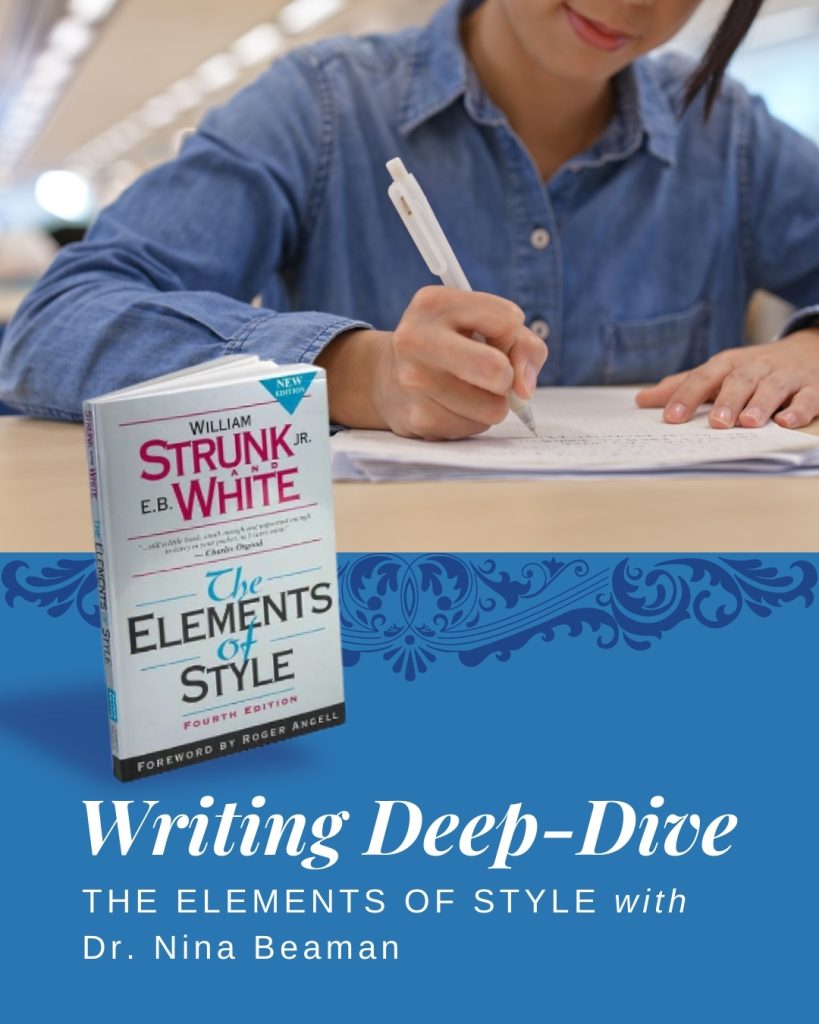
Understanding the rules of writing isn鈥檛 just about following grammar conventions鈥攊t鈥檚 about clearly communicating your ideas, especially in scholarly and professional settings. In this five-part video series, Dr. Nina Beaman guides viewers through key concepts from The Elements of Style by William Strunk Jr. and E.B. White. Whether you鈥檙e returning to school, preparing for a capstone project, or looking to polish your writing for the workplace, this classic book provides timeless strategies that can elevate your communication.
听
We鈥檝e summarized the highlights from each session below. Be sure to watch the full videos, embedded throughout the post, for in-depth explanations and examples.
听
Session 1 鈥� Elementary Rules of Usage
The first session focuses on the foundations of proper sentence structure and punctuation. One important concept is possessives鈥攗sed to indicate ownership. For example, “Dr. Beaman鈥檚 students” shows that the students belong to Dr. Beaman. However, personal possessive pronouns (his, hers, theirs, its, ours, yours) do not use apostrophes. A common mix-up is 鈥渋t鈥檚鈥� (which means 鈥渋t is鈥�) versus 鈥渋ts鈥� (which shows possession):
鈥淚t鈥檚 a wise dog who licks its own wounds.鈥�
Next, the proper use of commas is emphasized. For instance, when listing three or more items, a comma is used before the final conjunction:
鈥淩ed, white, and blue.鈥�
However, this rule may not apply to names of businesses, such as Little, Brown and Company.
Commas also help set off parenthetical expressions鈥攑hrases that add clarification but aren鈥檛 essential to the sentence. If the sentence still makes sense without the phrase, it鈥檚 parenthetical:
鈥淭丑别 instructor, Dr. Beaman, required the assignment to be turned in by Monday.鈥�
(Remove the name and the sentence still works: 鈥淭丑别 instructor required the assignment by Monday.鈥�)
Other common comma rules include:
- In dates: April 12, 2025
- With titles: Dr. Nina Beaman, Ed.D., RN
- Before a conjunction joining independent clauses:
鉁� 鈥淭丑别 assignment is due Friday, and it involves writing a three-page essay.鈥�
鉂� 鈥淭丑别 assignment is due on Friday, it involves writing a 3-page essay.鈥� Without the conjunction 鈥渁nd鈥� this becomes a run-on sentence.
鉂� 鈥淭丑别 assignment is due on Friday; it involves writing a 3-page essay.鈥� The semicolon is not needed.
鉂� 鈥淭丑别 assignment is due on Friday. Writing a 3-page essay.鈥� The second sentence is incomplete.
Note: Conjunctions are 鈥渁nd鈥� and 鈥渂ut鈥�. These join sentence parts, and they should not be used at the start of sentences.
Colons are another useful punctuation mark. They introduce lists, appositives (clarifying phrases), amplifications, and quotations. For example:
鈥淭丑别se are the strengths of this student: thoroughness, communication, and collaboration.鈥�
鈥淭丑别 instructor said: 鈥業 will accept late work this week, due to the snow.鈥欌��
Dashes provide emphasis and highlight interruptions or summaries:
鈥淭丑别 student was worried about success in the course鈥攆eeling very poorly prepared for the rigor of the advanced level鈥攏onetheless, they persevered.鈥�
鈥淭丑别 negative effect of violence in gaming on teenage minds might be overstated, as recent studies show鈥攑erhaps videogames are simply the contemporary scapegoat for the moral panic that previously targeted movies, comic books, and novels.鈥�
Grammatical agreement between subject and verb is also key. Consider:
鈥淭丑别 students, each opening a notebook, were ready for class.鈥�
Use singular verbs with pronouns like everyone, nobody, or someone:
鈥淓惫别谤测one agrees to do the work.鈥�
Use the proper case of the pronoun. The 7th edition of the APA style guide made a change to remove bias and avoid saying 鈥渉e or she, his/her,鈥� which is clumsy. When gender is not known, using they/them/their is correct and shows gender neutrality rather than plurality.听
鈥淭丑别 student did not want their work shown to others.鈥�
Avoid using 鈥渦s鈥� unless there are multiple authors, or 鈥淚, me, my, mine鈥� unless it is specifically a student reflection.
Finally, make sure participial phrases at the beginning of sentences refer to the correct subject:
鉁� 鈥淐oncerned about his grade, Cameron reached out to the teacher.鈥�
鉂� 鈥淐oncerned about his grade, the librarian helped him.鈥� (This incorrectly implies the librarian was concerned.)
听
Session 2 鈥� Elementary Principles of Composition
Writing academically means understanding purpose and audience. Review your assignment鈥檚 rubric or template, and identify your readers鈥攊nstructors, classmates, professionals?
Each paragraph should be a fully developed unit, typically with at least three sentences and a clear transition to the next. Use a strong topic sentence and stay focused.
Helpful guidelines:
- Prefer active voice (e.g., 鈥淭丑别 student completed the assignment鈥� rather than 鈥淭丑别 assignment was completed鈥�).
- Use positive, concrete language.
- Be objective鈥攁void unnecessary adjectives and adverbs.
- Eliminate fluff that doesn鈥檛 add meaning.
Watch for loose sentences鈥攕trings of simple clauses that lack structure鈥攁nd avoid redundancy. Maintain consistency in tense, and place important words at the end of sentences for emphasis.
Before turning in your work, ask:
- Does it meet the requirements?
- Are paragraphs logically organized?
- Are sentences active, concise, and objective?
- Is the conclusion a strong, cohesive summary?
Here’s a previous blog post that covers paragraph structure in more detail!
听
Session 3 鈥� A Few Matters of Form
This session focuses on formatting and clarity.
Avoid colloquialisms, especially abbreviations that could confuse the reader. For example:
- 鈥淰A鈥� could mean Veterans Affairs or Virginia.
- 鈥淣P鈥� could be Nurse Practitioner or National Park.
Use more formal alternatives:
- Instead of via, say through.
- Instead of as per, say according to.
Exclamation points rarely belong in scholarly work.
鉁� 鈥淚 really liked the course.鈥�
鉂� 鈥淚 really liked the course!鈥�
Hyphens are used to combine multiple words into adjectives (e.g., evidence-based), but APA style discourages unnecessary hyphenation, especially with prefixes like pre, post, and non.
Use proper margins (1 inch on all sides), indent the first line of each paragraph, and apply APA-style headings for organization. Student papers don鈥檛 require a running header, but journal submissions might.
For numbers, write:
August 27, 1994
Not: August 27th, 1994
Parentheses should be punctuated outside:
(Glidewell & Bolgiano, 2025).
Quotations require proper punctuation and citation. For longer quotes, use block formatting.
For titles, remember:
- On the title page and in the body: Capitalize major words and italicize the title.
顿颈肠办别苍蝉鈥檚 A Tale of Two Cities - In references: Use sentence-style capitalization (only the first word and proper nouns are capitalized).
听
Session 4 鈥� Words and Expressions Commonly Misused
Precision matters. Here are some commonly confused word pairs:
- Aggravate (to add to or make worse) vs. Irritate (to annoy)
- Allude (to refer indirectly) vs. Elude (to escape)
- Effect (noun: result) vs. Affect (verb: to influence)
- Further (abstract) vs. Farther (physical distance)
Grammar tip: That introduces a restrictive clause (essential to the sentence), while which introduces a non-restrictive clause (nonessential and set off by commas).
鈥淭丑别 paper that was late received half credit.鈥�
鈥淭丑别 paper, which was late, received half credit.鈥�
Be cautious with words like:
- Disinterested (impartial) vs. uninterested (not engaged)
- Nauseous (causing nausea) vs. nauseated (feeling sick)
Avoid redundant phrases like:
- 鈥淎s yet鈥� 鈫� just say 鈥測et鈥�
- 鈥淐urrently鈥� 鈫� often unnecessary
- 鈥淭丑别 fact that鈥� 鈫� usually can be cut
Use specific, concrete language instead of vague or overused adjectives like interesting, meaningful, or nice. Academic writing should allow readers to form their own conclusions.
听
Session 5 鈥� An Approach to Style
Writing well means writing with intention. Let the subject matter鈥攏ot your personal opinions鈥攖ake center stage.
- Write naturally, then revise for clarity and conciseness.
- Use transitions to guide the reader.
- Follow provided templates and rubrics carefully.
- Ensure subject-verb agreement.
Embrace the process: organize your thoughts, write a draft, revise thoroughly, and seek feedback.
Avoid unnecessary embellishments or 鈥渇luff.鈥� Let your evidence speak clearly and your structure guide the reader. Scholarly writing is a craft鈥攁nd like any skill, it improves with practice. By mastering the core lessons from The Elements of Style, you鈥檒l gain confidence in your academic writing鈥攁nd you鈥檒l be better equipped to express your ideas clearly, concisely, and professionally.
听
Happy writing!
Source:
Strunk, W., & White, E. B. (2000). The Elements of Style (4th ed.). Pearson Education.
Dr. Nina Beaman is the Graduate Partnership Liaison at 久久视频, as well as the Dean Emerita of the School of Nursing and Health Sciences.
Additional writing resources:
, also presented by Dr. Beaman
webinar presented by 久久视频 faculty member Negean Mohi